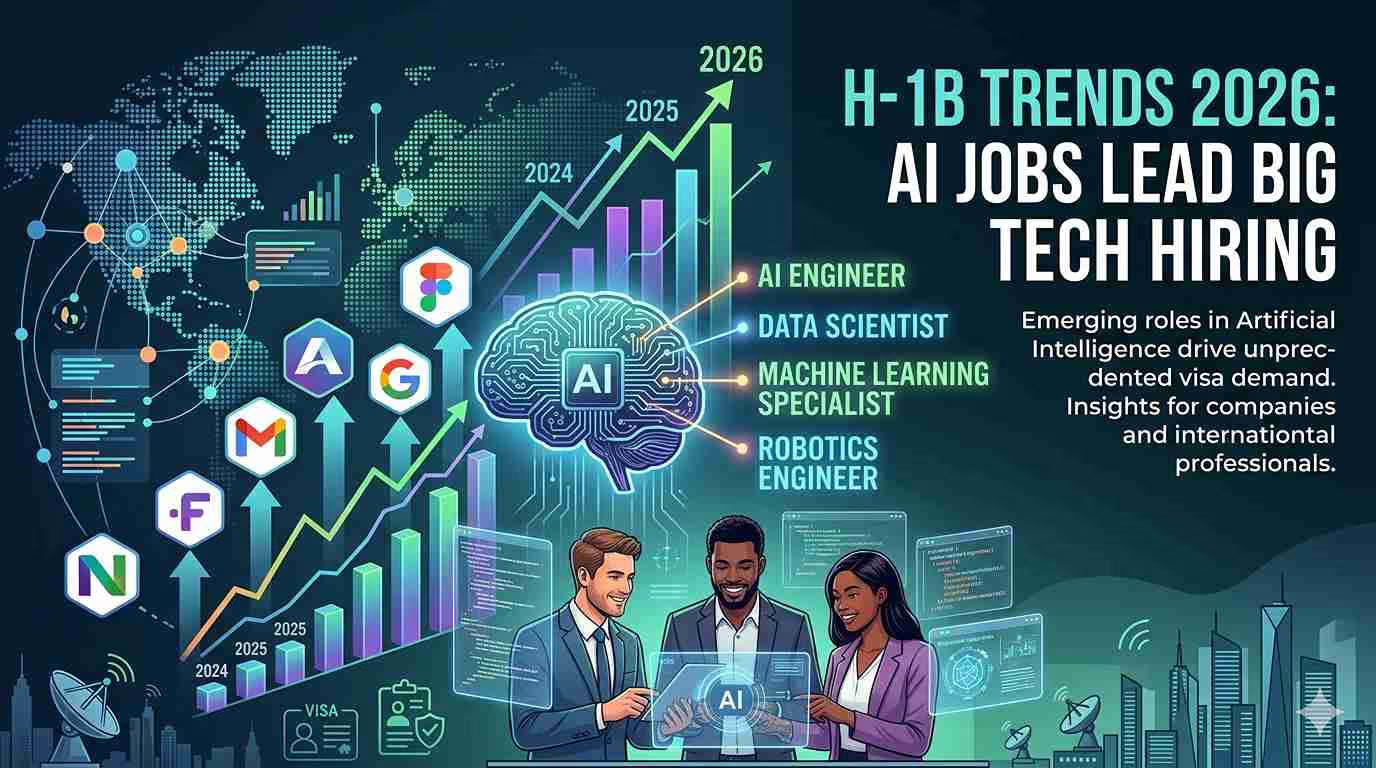
If there is one career investment that pays off across every tech role in 2026, it is AI skills. Artificial intelligence has moved from a specialist niche to a baseline expectation — and for Indian professionals, who power so much of global IT, building the right AI skills is the surest way to stay in demand, justify visa sponsorship, and move up the value chain.
This NRIGlobe guide lists the top AI skills to learn in 2026, why each matters, and a practical roadmap to build them — whether you are a student, a working professional, or planning a switch into AI.
Note: This is general guidance, not career or financial advice. The AI field moves fast — treat this as a starting map and keep learning from current, hands-on sources.
Why AI Skills Matter More Than Ever
- AI is now embedded across software, data, security, product, and operations roles
- Employers increasingly screen for AI capability — even outside "AI jobs"
- AI-native professionals are far more productive, which protects and elevates careers
- Scarce, hard-to-automate AI skills strengthen the case for H-1B sponsorship
The Top AI Skills to Learn in 2026
1. Foundational Machine Learning
Understand the core concepts — supervised/unsupervised learning, model training, evaluation, overfitting, and the math intuition behind it. This foundation makes everything else easier.
2. Generative AI & LLMs
Know how large language models work, their strengths and limits, and how to build with them — embeddings, retrieval-augmented generation (RAG), fine-tuning basics, and evaluation.
3. Prompt Engineering & Agentic AI
The fastest-growing applied skill: designing effective prompts, building tool-using "agents," and orchestrating multi-step AI workflows that actually ship value.
4. Python & AI Frameworks
Python remains the lingua franca of AI. Get comfortable with the major libraries and AI/ML frameworks used to build, fine-tune, and deploy models.
5. Data Engineering
AI is only as good as its data. Skills in data pipelines, cleaning, vector databases, and feature management are in heavy demand and pair perfectly with AI roles.
6. MLOps & AI Deployment
Taking models from notebook to production — versioning, monitoring, scaling, and reliability. MLOps is where many AI projects succeed or fail.
7. Cloud Skills (AWS / Azure / GCP)
AI workloads run on the cloud. Cloud architecture and the AI/ML services of the major providers are highly marketable, often via recognised certifications.
8. AI Security & Governance
As AI spreads, so do its risks. Skills in AI security, safety, bias mitigation, and governance/compliance are emerging high-value specialisations.
9. Domain Expertise + AI
The biggest edge: combine AI with deep knowledge of a domain — healthcare, finance, law, supply chain — to build solutions generalists can’t.
10. Human Skills That AI Can’t Replace
Problem framing, communication, judgment, and leadership. As AI handles more execution, these differentiate senior careers.
A Practical Learning Roadmap
- Build Python fundamentals (if you don’t already have them)
- Take a structured ML/AI course and one cloud AI/ML certification
- Learn to build with LLMs — RAG, prompts, and a small agent project
- Ship 2–3 portfolio projects on GitHub that solve real problems
- Pick a specialisation (MLOps, data engineering, AI security, or a domain) and go deep
- Stay current — follow releases, read docs, and keep building monthly
How to Learn (Without Wasting Time)
- Prioritise hands-on projects over passive video-watching
- Earn one credible certification employers actually screen for
- Use AI tools daily in your current job to compound your skills
- Join communities and contribute — learning accelerates in public
- Re-build, don’t just follow tutorials — depth comes from doing it yourself
Frequently Asked Questions (FAQ)
Do I need a PhD to work in AI?
No. Many high-demand AI roles (applied AI, AI engineering, MLOps, data engineering) value strong practical skills and a project portfolio over advanced degrees.
Which single AI skill is most valuable right now?
Building with LLMs — RAG, prompt engineering, and agentic workflows — is the fastest-growing applied skill, especially combined with solid software and data fundamentals.
Are cloud certifications worth it?
Yes — cloud AI/ML certifications (AWS/Azure/GCP) are widely screened for and pair naturally with AI deployment skills.
How long does it take to become job-ready in AI?
With consistent effort and real projects, many professionals build job-ready applied-AI skills in several months — faster if they already code.
Final Take
The winning formula in 2026 is simple to state and demanding to execute: become AI-native, go deep in one specialisation, pair it with domain expertise, and never stop building. For Indian professionals, these skills are the strongest hedge against disruption and the clearest path to senior, well-paid, sponsor-worthy roles.
Which AI skill are you focusing on this year? Share it in the comments and subscribe to NRIGlobe for more career and upskilling guides for the Indian diaspora.
Related Reading on NRIGlobe
- AI’s Impact on Indian Tech Careers: What NRIs Should Know
- NRI Career Guidance 2026: In-Demand Fields, Visa & Upskilling
- H-1B Visa Updates 2026: What Indian Professionals Need to Know
- GCCs in India: The New Career Magnet for Returning NRIs