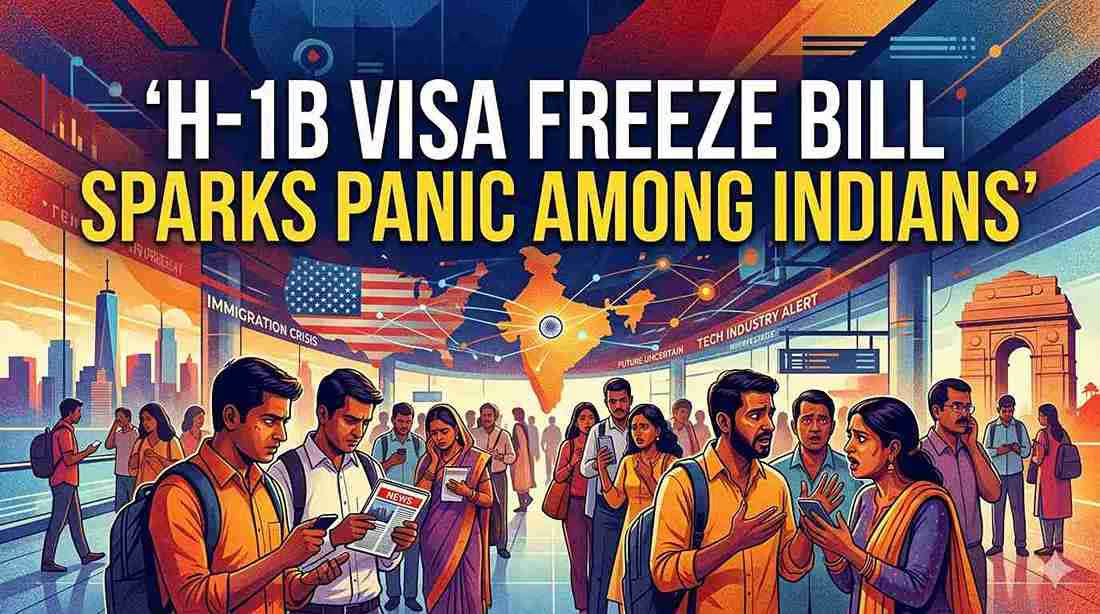
The H1B visa has always been the single most important document in the Indian-American working class. In May 2026, after a year of executive orders, fee hikes and a White House that openly questions the program's design, that document feels less stable than at any point since 2017. Indian professionals — who hold roughly 72 percent of all H1B approvals — have moved from confidence to contingency planning, and many are quietly drawing up Plan B options that did not exist in their playbook two years ago.
This survival guide pulls together what the Trump administration has actually changed in 2026 versus what is rumour, what it means for renewals and green-card timelines, the legal moves that work and the ones that do not, and the realistic alternatives — EB-5, O-1, Canada Express Entry, the UAE Golden Visa, and India-return packages now being structured by hyperscalers. The aim is calm, useful planning, not panic.
What has actually changed for H1B in 2026
The 2026 H1B picture has three confirmed shifts and a longer list of pending proposals. Sorting confirmed from rumoured is the first job.
Confirmed changes
- Higher filing fees: A 2025-finalised fee structure raised total employer-side H1B costs into the $5,000–$8,000 range per beneficiary, hitting smaller employers hardest.
- Wage-level prioritisation in the lottery: The 2026 cap-subject lottery weighted higher-paying registrations more heavily. Entry-level Wage Level I registrants saw selection probabilities drop sharply versus 2024.
- Increased site visits and RFEs: USCIS field officers have stepped up Fraud Detection and National Security (FDNS) checks at IT consulting employers. Request-for-Evidence rates on amendments and extensions are elevated.
Proposed but not yet final
- Re-definition of "specialty occupation" that could narrow eligibility for some IT roles.
- A possible $100,000 minimum salary floor for new H1B petitions, floated in the press but not in any signed rule as of this writing.
- Tighter rules around third-party placements and "benched" workers.
Treat the proposed items as risk scenarios, not as plan inputs. Plan against confirmed rules; track proposals weekly through our visa news section.
Why Indian techies are most exposed
The math is simple: of the roughly 85,000 cap-subject H1B slots each year, India-born nationals consistently take 65 to 75 percent. Most of those professionals are concentrated in software engineering, data engineering, cloud architecture, and increasingly AI/ML roles. They are also disproportionately stuck in the EB-2 green-card backlog, which for Indian-born applicants now stretches past two decades.
That combination — heavy H1B reliance plus the longest green-card wait of any nationality — means policy turbulence hits Indian professionals harder than any other diaspora. A Saudi or German national filing today might see permanent residency in three years. An Indian engineer with the same approval might wait 25.
Real stories: who is leaving, who is staying
Survey data from Carnegie India and informal exit polls inside major Indian-American professional networks in early 2026 tell a consistent story:
- Roughly one in five Indian H1B workers is "actively exploring" return to India or relocation to Canada within 24 months.
- One in three has begun the OCI or PIO documentation process for their US-born children — a defensive move that does not commit to leaving but creates the option.
- The most committed stayers are mid-career engineers at top-of-pay-band roles with adjudicated I-140s and approved EAD spouses.
The pattern is not a mass exodus; it is increased optionality. Indian engineers who five years ago saw the US as a one-way ticket are now treating it as a portfolio decision.
Legal moves that work in 2026
If you are inside the system, several practical legal tactics meaningfully reduce risk.
Lock down your I-140
An approved I-140 is the single most important defensive document an Indian H1B holder can have. It enables AC-21 extensions beyond the six-year H1B cap and protects priority date portability if you change employers. If your employer has not started the PERM-to-I-140 sequence, raise it directly with HR this quarter.
Keep H1B amendments current
Any material change in job duties, work location, or pay level requires an amendment. USCIS scrutiny on this has gone up; do not let it slip.
Spouse and dependent strategy
H4 EAD remains valid for spouses of H1B holders with approved I-140s. Keep the EAD timeline aligned with the H1B renewal cycle so neither lapses. Some families are also using O-1 (for "extraordinary ability") and L-1B transfers as alternatives.
Travel carefully
Premium processing has improved 2025-26, but stamping appointments at US consulates in India — Mumbai, Hyderabad, Chennai — still see administrative-processing delays of two to six weeks. Avoid travel during a pending extension. If you must travel, line up backup work-from-India arrangements in writing with your employer.
Alternative pathways worth considering
For families who want a Plan B beyond traditional H1B → I-140 → green card, four serious options are gaining traction in 2026.
EB-5 Investor Visa
The minimum investment for EB-5 in a Targeted Employment Area is $800,000 in 2026. It bypasses the per-country quota in some scenarios and offers a faster route to a green card for families with the capital. Reputable regional centres and direct project investments are the two structures most commonly used; both require careful due diligence and a competent EB-5 attorney.
Canada Express Entry
Canada's Comprehensive Ranking System favours US-experienced tech workers, particularly with Master's degrees and English-language CLB 9+. Indian engineers with three to five years of US H1B work often qualify within two to four months. Toronto, Vancouver and Calgary now have functional Indian-tech sub-communities; salaries are lower than the US but tax and healthcare offsets are real. Read more on visa alternatives as you weigh options.
UK Global Talent and Skilled Worker
The UK has become surprisingly accessible for senior Indian engineers in AI and life sciences. Fees are higher than Canada but processing is fast.
India-return packages
Hyperscalers (Google, Microsoft, Amazon) and a wave of US-based AI startups are offering "soft-landing" India returns — relocation budgets, US-rate retention for 12-24 months, and managerial track promises. For Indian-Americans whose parents need them in India, these packages can be a real choice rather than a defeat.
Economic impact of an H1B slowdown
If H1B issuance falls 30 percent over the next two years, the US tech sector loses access to roughly 25,000 skilled engineers per year. Compensation for US-citizen technical roles rises modestly in the short term but project delivery slows, particularly in cloud and AI infrastructure. Indian IT services firms (TCS, Infosys, Wipro) benefit from increased near-shore demand. The net effect for the US economy is, at best, ambiguous.
Long-term outlook
H1B has survived four administrations of every political stripe because the US tech economy depends on it. The most realistic 2026-2028 outlook is not a programme cancellation but a programme that becomes more expensive, more contested, and more concentrated among large employers paying senior-level wages. Indian families with mid-career, well-paid, large-employer H1Bs are likely to ride this out comfortably. Early-career engineers at smaller IT consulting firms face the most uncertainty.
Frequently Asked Questions
Will H1B be abolished in 2026?
No. There is no serious bill in Congress to end H1B, and the major US tech employers actively lobby for the programme. Expect higher costs and stricter scrutiny, not abolition.
What is the safest visa status for an Indian professional in the US right now?
An approved I-140 plus H1B in your seventh year or beyond, with a current AC-21 extension, is the most defensible position. EAD on H4 (with spouse's approved I-140) is also strong.
Should I switch to a US citizen-friendly employer?
Counterintuitively, no. The biggest employers of Indian H1B workers — Amazon, Microsoft, Google, Apple, Meta — are also the most sophisticated at navigating policy changes. Smaller IT-consulting employers have higher RFE rates.
Is Canada really a viable alternative?
For senior Indian engineers, yes. For early-career professionals, the salary cut is real (often 25-35 percent lower than equivalent US compensation) and the tech market is smaller. Calgary's energy-tech and Toronto's fintech are the strongest current hubs.
What if my H1B is denied this year?
Speak to a licensed immigration attorney within seven days. Do not work for the employer past the denial date. Options include motion to reopen, transfer to a different status (B-2, F-1), or controlled return to India. The worst response is delay.
How does the green-card backlog affect this?
The EB-2 backlog for Indian-born applicants is currently in the 2003-2004 priority-date range and is expected to remain roughly flat. EB-3 has moved more recently but cross-charging strategies are complex. Talk to a green-card specialist about EB-1A and EB-2 NIW eligibility.
What you should do this week
- Pull your most recent I-797 H1B approval notice and confirm the validity end date.
- Email HR or your immigration counsel to confirm I-140 status and PERM timeline.
- If you have a spouse on H4 EAD, calendar the renewal date now and start papers 180 days in advance.
- Update your LinkedIn and résumé so it works for both US and Canada/UK markets, even if you do not intend to leave.
- Make sure your US-born children have valid US passports and OCI cards — both. The cost is trivial and the optionality is enormous.
The H1B story in 2026 is uncomfortable but not unmanageable. Indian-American professionals who plan calmly, lock in their best legal protections, and keep two or three alternative pathways warm are the ones who will look back on this period as a stressful chapter rather than a career-defining loss.